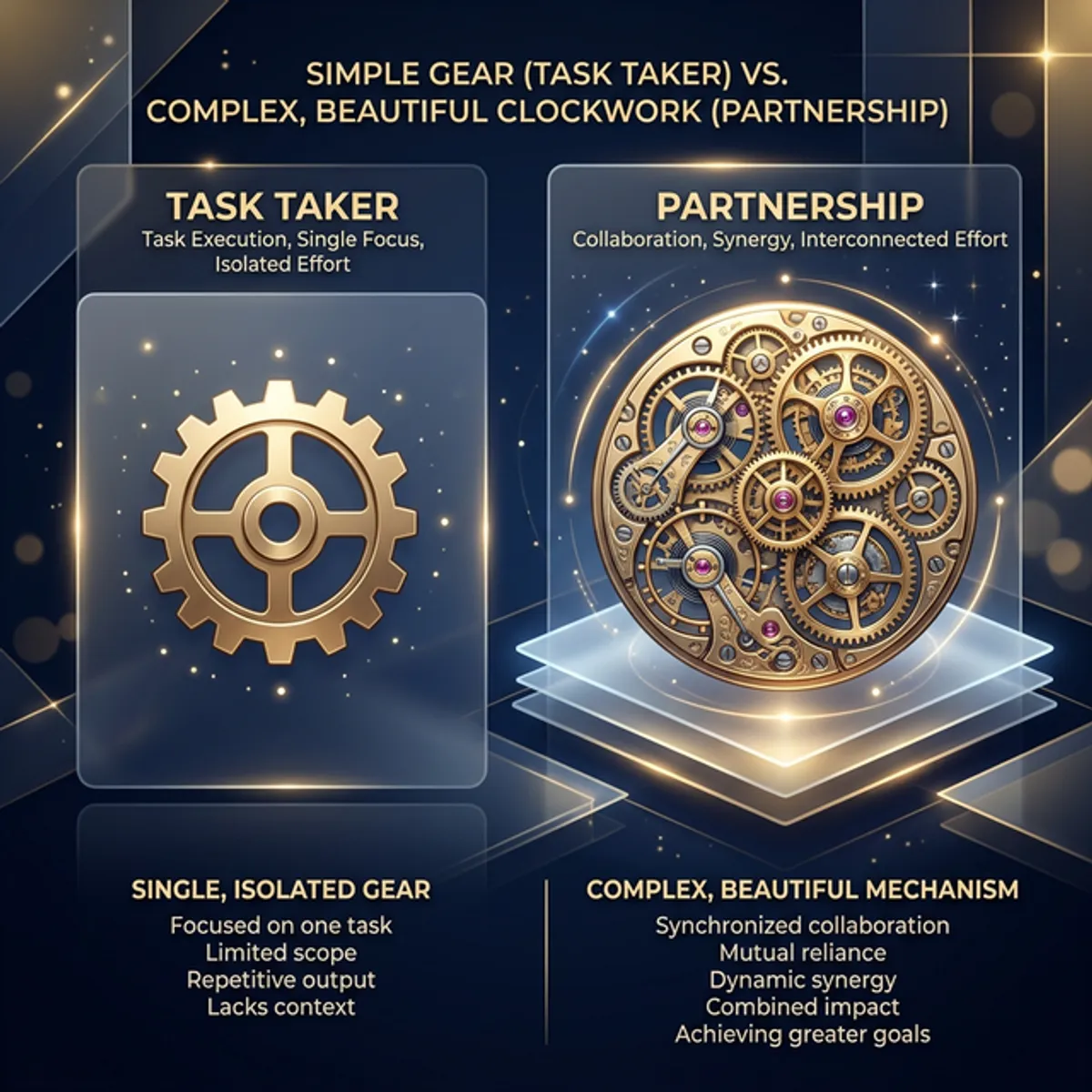
Strategic Partnership vs. Task Taker: Why Your Business Needs a Co-Pilot
Strategic Partnership vs. Task Taker
Is your support checking boxes or building your empire?
In the fast-paced business environment of 2024, there is a fundamental distinction that will either propel your business forward or keep it tethered to the ground: the difference between a Task Taker and a Strategic Partner.
If you feel like you are still “managing” your help more than you are “leading” your company, you have likely hired a pair of hands when what you actually need is a head.
What You'll Learn
- The 4-point litmus test to evaluate your current support
- Why delegating 'Outcomes' beats delegating 'Tasks'
- How to move from management to leadership
- The structural impact of an owner-mindset partner
The Litmus Test: How to Tell the Difference
It can be hard to spot the difference in the day-to-day bustle, but the long-term results tell the story. Use this checklist to evaluate your current support:
The Task Taker:
- Completes exactly what you asked for – no more, no less.
- Asks “What do I do next?” as soon as a project finishes.
- Highlights problems but waits for you to provide the solution.
- Result: Your workload feels the same; you’ve just added “Management” to your list.
The Strategic Partner:
- Looks at a task and suggests a system to automate it (using tools like Google Apps Script).
- Asks “How does this align with our quarterly goals?”
- Highlights problems and presents three possible solutions before you’ve even seen the issue.
- Result: Your mental load lightens; you feel like you have a co-pilot, not a subordinate.
Better Delegation in 2024: The “Outcome” Framework
To attract and keep a Strategic Partner, your delegation style must evolve. If you delegate a task, you get a Task Taker. If you delegate an outcome, you empower a Partner.
- Stop delegating the “How”: Don’t say, “Please copy these names into this spreadsheet.” Instead, say, “I want a system where every new lead is automatically tracked and their follow-up is scheduled.”
- Give context, not just commands: A partner needs to know the “Why.” When they understand the goal – such as moving from episodic income to consistent revenue – they can make decisions in your absence that align with that vision.
- Establish High-Level Boundaries: A Strategic Partner doesn’t need to be micromanaged. Set clear KPIs and then step back. This allows them to step into their authority and gives you the space to step into yours.
Building Your Empire
A Task Taker keeps the lights on. A Strategic Partner builds the walls, installs the plumbing, and ensures the foundation can support a skyscraper.
At Empower Virtual Assistant Services, we don’t just check boxes. We look for the “High-Level Evolution” in every process, turning manual handling into structural growth. When your support starts thinking like an owner, your business starts growing like an empire.
Conclusion: Audit Your Support
Is your current VA an architect of your freedom or just another item on your to-do list? It is time to stop paying for activity and start investing in outcomes.
Take an hour this week to audit your operational bottlenecks. If you are still the only one solving the problems, you haven’t found your partner yet.
Explore More Insights
Why Your Business Needs a Tech Specialist, Not Just a 'Helper'
'Help' is a vague metric. Discover why the gap between a Generalist and a Tech specialist is the difference between surviving and scaling.
Outsourcing the Overwhelm: A Guide to Ethical Delegation
Delegation isn't lazy; it's a structural necessity. Learn how to move from 'hiring a helper' to 'partnering with an expert' while protecting your mental capacity.