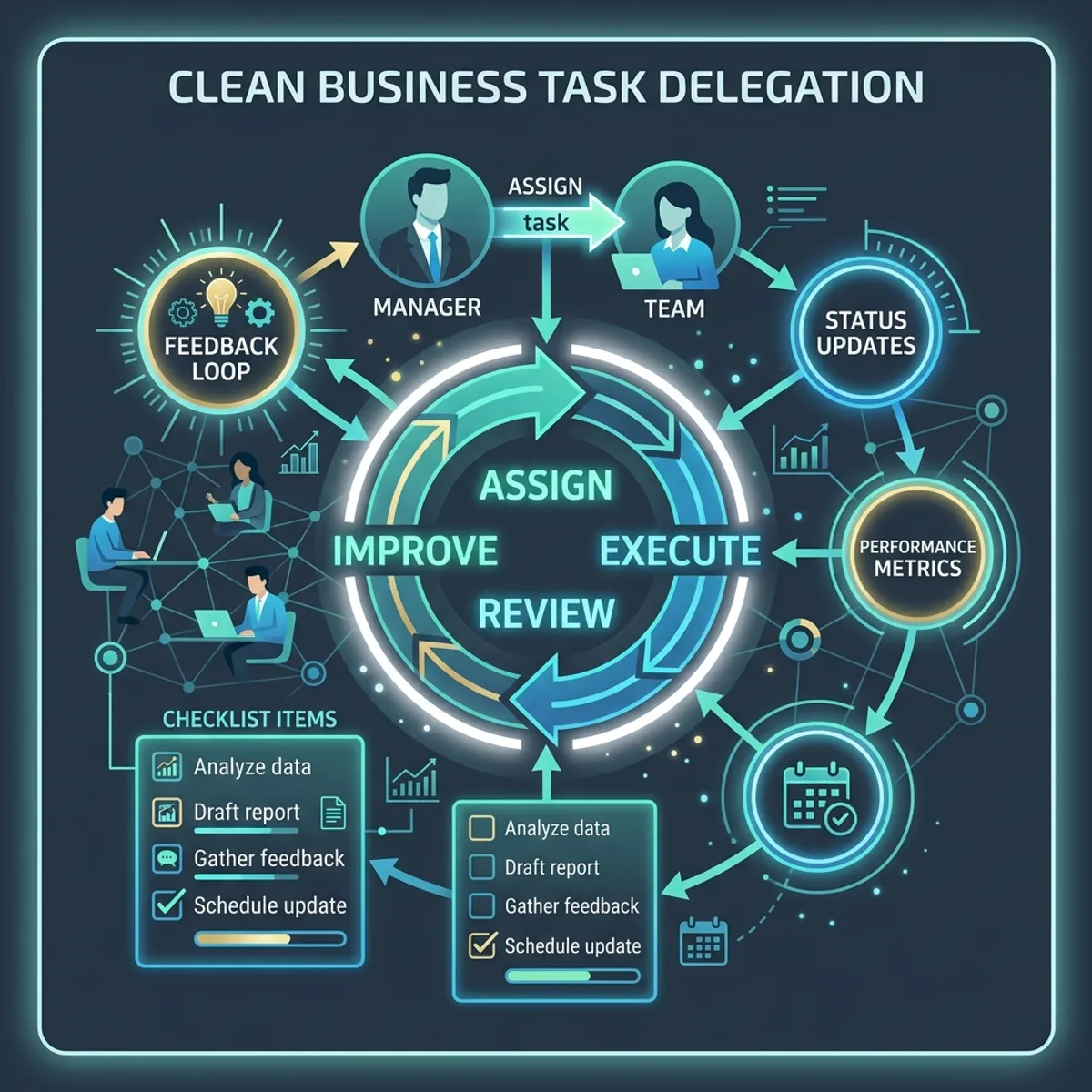
The Art of Delegation: How to Brief Your VA Without Micromanaging
The Art of Delegation: How to Brief Your VA Without Micromanaging
The line between clear instructions and constant hovering is thinner than you think.
What You'll Learn
- Why Delegation Feels Hard
- The Briefing Framework
- What Micromanagement Actually Looks Like
- How to Let Go (Without Losing Control)
Why Delegation Feels Hard
You built this business. You know how everything works. You have standards. And handing work to someone else feels like giving away control.
So when you finally delegate, you tend to do one of two things:
Under-delegate: “Just handle my emails.” Then you’re frustrated when the results don’t match your expectations : expectations you never communicated.
Over-manage: You check every email before it’s sent, question every calendar decision, and spend more time reviewing your VA’s work than it would take to do it yourself.
Both approaches fail. The first produces poor results. The second produces resentment (yours and theirs) and no time savings.
Effective delegation lives in between: clear enough that the VA knows what good looks like, loose enough that they can do the work without you watching.
The Briefing Framework
Every delegated task needs five things. Skip any of them and you’ll end up frustrated.
1. The Outcome
What does “done” look like? Not the process, but the result.
Weak: “Send follow-up emails.” Strong: “Every client who received a proposal more than 3 days ago and hasn’t responded should get a follow-up email. The goal is to prompt a response : accept, reject, or ‘need more time.’”
The outcome tells your VA what success looks like. They can figure out the best way to get there.
2. The Boundaries
What can they decide? What needs your input?
Example: “For standard enquiries (pricing, availability, scope questions), respond directly using the templates. For anything unusual (a complaint, a request for a service we don’t offer, or a VIP client) draft a response and send it to me before sending.”
Boundaries prevent both over-caution (“she checks everything with me before doing anything”) and over-confidence (“she sent a reply I wouldn’t have approved”).
3. The Standards
What level of quality and style do you expect?
Example: “Emails should match my tone : professional but warm. Sign off with ‘Best wishes, Nicola.’ Always proofread for typos. If it’s client-facing, it needs to be flawless.”
Don’t assume your standards are obvious. What’s “professional” to one person is “stuffy” to another. Show examples of work you consider good.
4. The Timing
When does it need to happen, and how often?
Example: “Inbox triage happens twice daily : 9am and 2pm. Follow-up emails go out every Wednesday. Invoice reminders are sent the day after they’re overdue.”
Without timing, tasks drift. With timing, they become a reliable system.
5. The Feedback Loop
How will you know it’s working? How will you give feedback?
Example: “Send me a daily summary at 4pm with what was handled, what was flagged, and any questions. In the first two weeks, I’ll review and give feedback daily. After that, we’ll do a weekly check-in.”
What Micromanagement Actually Looks Like
You might not think you’re micromanaging. But if you’re doing any of these, you probably are:
- Checking every email your VA sends (after the first two weeks)
- Rewriting their work instead of giving feedback : “Just let me do it” undoes the delegation
- Asking for status updates multiple times a day : if you need to know that often, you haven’t set up reporting properly
- Dictating the process instead of the outcome : “Click here, then here, then type this” instead of “Make sure every new client gets a welcome email within 2 hours”
- Redoing their work silently : the worst kind, because they never learn what was wrong
Why It’s Damaging
Micromanagement doesn’t just waste your time; it actively undermines the relationship:
- Your VA stops taking initiative because every decision gets overruled
- They become less confident, not more
- They stop flagging ideas and improvements because what’s the point
- You get frustrated that they “can’t work independently”, but you never let them
How to Let Go (Without Losing Control)
Start With Low-Stakes Tasks
Don’t hand over your biggest client’s communication on day one. Start with filing, data entry, scheduling: tasks where mistakes are easily caught and quickly fixed.
As confidence builds on both sides, move to higher-stakes work.
Define “Good Enough”
Not every task needs to be done exactly how you’d do it. Some tasks just need to be done.
If your VA organises your Drive folders using a slightly different naming convention than you’d choose (but everything is findable and consistent) that’s good enough. Save your standards for client-facing work.
Review Outputs, Not Process
Check what was produced, not how it was produced. If the emails are professional, timely, and effective, does it matter that your VA composes them in a different order than you would?
Outcome-focused management is trusting. Process-focused management is controlling.
Schedule Your Check-Ins
Random, unprompted check-ins feel like surveillance. Scheduled check-ins feel like collaboration.
A daily 5-minute stand-up and a weekly 30-minute review gives you visibility without hovering. Outside those times, let them work.
Give Feedback, Not Criticism
There’s a difference:
Criticism: “This email is wrong.” Feedback: “This email is almost perfect : I’d just change the tone in the second paragraph to be a bit warmer. For context, this client is quite informal and prefers a chatty style.”
Feedback explains the why. It helps the VA learn your preferences and apply them independently next time. Criticism just makes them anxious.
The Delegation Maturity Model
Most client-VA relationships evolve through these stages:
Stage 1: Directive (Weeks 1-2)
You tell the VA exactly what to do and check the output. This is appropriate and necessary; they’re learning your business.
Stage 2: Guided (Weeks 3-6)
You describe the outcome and let the VA choose the approach. You review key outputs and provide feedback. Most tasks are running independently.
Stage 3: Autonomous (Months 2-3)
The VA handles routine work without oversight. They make judgement calls within agreed boundaries. You review periodically, not constantly.
Stage 4: Strategic (Months 4+)
The VA anticipates needs, suggests improvements, and flags opportunities. They’re not just executing; they’re thinking. You’re having strategic conversations, not task-level ones.
Most delegation failures happen because the business owner gets stuck in Stage 1 and never progresses. The key is consciously moving through the stages.
Practical Tips for Better Briefing
Use voice notes. A 2-minute voice note is faster than a 10-minute typed brief and conveys tone, priority, and nuance that text misses.
Show, don’t tell. A screenshot with an arrow saying “like this” communicates more than 200 words of description.
Create templates together. Don’t hand your VA a finished template : create it together. They’ll understand the thinking behind it, not just the format.
Batch your briefing. Instead of sending tasks one at a time throughout the day, batch them into a morning brief. This gives your VA focused work blocks instead of reactive interruptions.
Say thank you. Your VA is a professional, not a servant. Acknowledging good work costs you nothing and builds a relationship that produces better results.
The Goal: Making Yourself Unnecessary
The ultimate sign of successful delegation is this: your VA handles a situation you didn’t anticipate, in a way you would have handled it yourself, without asking you.
That doesn’t happen through micromanagement. It happens through clear briefing, consistent feedback, growing trust, and the discipline to let go.
Ready to Delegate Properly?
At Empower VA Services, we make delegation easy. We guide you through the briefing process, set up the right feedback loops, and reach autonomy quickly, so you get your time back without losing control.
We’ll show you how to hand over work effectively, starting with the tasks that’ll make the biggest difference.
Nicola Berry is the founder of Empower VA Services, based in Falkirk, Scotland. Making delegation feel natural, not nerve-wracking.